
United States Health Insurance
How Health Insurance Works
Pick a plan
There are many different plans, outlined on the Health Insurance Options page. Eligibility for plans is based on employment, income, age, and health. Various plans cover a mix of services and providers, but under the Affordable Care Act the following are considered "essential health services:"
-
Emergency services
-
Hospitalization
-
Laboratory tests
-
Maternity and newborn care
-
Mental health and substance-abuse treatment
-
Outpatient care (doctors and other services you receive outside of a hospital)
-
Pediatric services, including dental and vision care
-
Prescription drugs
-
Preventive services (e.g., some immunizations) and management of chronic diseases
-
Rehabilitation services
Pay for a plan
As with services covered, payments for health insurance vary based on the plan.
Generally, health insurance plans require patients to pay a premium, which is typically a monthly payment.
From there, patients pay out-of-pocket costs. This is also known as cost-sharing. There are three main kinds of out-of-pocket payments
-
Copayment - a set amount patients are charged for an appointment, usually the day of.
-
Deductible - an amount that the patient has to pay before the insurance pays for covered services
-
Coinsurance - after meeting the deductible, coinsurance is the percentage of cost that the patient pays.
The annual out-of-pocket maximum is the maximum amount a patient can pay each year. It includes copayments, deductibles, and coinsurance, but does not include premiums
In addition to insurance costs, there is a Medicare tax. The Medicare tax is a federal tax of 2.9%, with half coming from employers and half from employees. It is used to pay for Medicare Part A (hospital insurance)
Why get health insurance?
Without health insurance, patients must pay the list prices for services. This is often expensive and hard to plan for. Even though insurance limits the choices available, the companies negotiate lower prices with the providers in their networks, so when care is necessary it is more affordable.
When people pay their insurance companies, they are essentially pooling their contributions with other patients. The majority of customers don't have large health bills every year, and so the insurance companies have enough money to cover the care of the few people who meet their deductibles and have high remaining costs.
Insurance companies also abide by the Law of Large Numbers, which basically means they are more confident in their predictions when they have more customers. Therefore, it is beneficial for insurance companies to have larger numbers of policyholders.
Example
Say you need to go to the doctor for a yearly check-up. First, you would pick a doctor that is part of your health insurance network.
When you get to your appointment, the doctor's office will ask for a copay, which you pay onsite.
The doctor then sends a bill. Because the doctor is in your network, the price you pay is lower than the list price. The normal cost for a check-up could be $100, but your insurance company and the doctor have an agreement that you'll only need to pay $50.
The copay and the $50 you paid the in-network doctor would count towards your yearly deductible.
If you have an unexpected injury, you would continue to visit in-network doctors (as possible). Eventually, the added costs would fulfill your deductible.
After meeting your deductible, you only need to pay your coinsurance- possibly 20% of the cost.
If you continue to require care, you could eventually reach your out-of-pocket maximum. In that case, the only remaining fee is your monthly premium. All of your appointment costs, as long as they remain in-network, would be paid by your insurer.
This scenario represents a simplified explanation of how a health insurance plan could work. Different plans have different policies, and even within the plans coverage, copayments, and coinsurance can vary depending on the type of care.
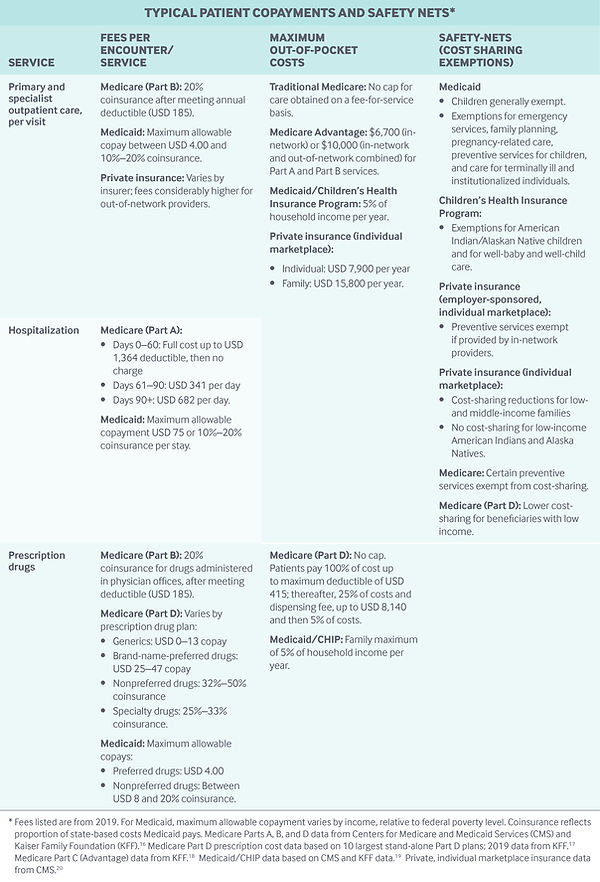
This chart from The Commonwealth Fund summarizes some examples of copay, coinsurance, and deductible costs.
“How U.S. Health Insurance Works.” How U.S. Health Insurance Works | Vaden Health Services, 2020,
vaden.stanford.edu/insurance/health-insurance-overview/how-us-health-insurance-works.
“Law of Large Numbers.” InvestProgram.org, 2020, www.investprogram.org/students/insurance-in-real-life/law-of-
large-numbers.
Tikkanen, Roosa, et al. “United States.” Commonwealth Fund, The Commonwealth Fund, 5 June 2020,
www.commonwealthfund.org/international-health-policy-center/countries/united-states.
“Topic No. 751 Social Security and Medicare Withholding Rates.” Internal Revenue Service, United States
Government, 22 Sept. 2020, www.irs.gov/taxtopics/tc751.